# Cloud Computing
- [Cloud Computing](#cloud-computing)
- [What is Cloud Computing?](#what-is-cloud-computing)
- [The Deployment Models of the Cloud](#the-deployment-models-of-the-cloud)
- [The Five Characteristics of Cloud Computing](#the-five-characteristics-of-cloud-computing)
- [Six Advantages of Cloud Computing](#six-advantages-of-cloud-computing)
- [Problems solved by the Cloud](#problems-solved-by-the-cloud)
- [Types of Cloud Computing](#types-of-cloud-computing)
- [Example of Cloud Computing Types](#example-of-cloud-computing-types)
- [Pricing of the Cloud – Quick Overview](#pricing-of-the-cloud--quick-overview)
- [AWS Cloud Use Cases](#aws-cloud-use-cases)
- [AWS Global Infrastructure](#aws-global-infrastructure)
- [AWS Regions](#aws-regions)
- [How to choose an AWS Region?](#how-to-choose-an-aws-region)
- [AWS Availability Zones](#aws-availability-zones)
- [AWS Points of Presence (Edge Locations)](#aws-points-of-presence-edge-locations)
- [Tour of the AWS Console](#tour-of-the-aws-console)
- [Shared Responsibility Model](#shared-responsibility-model)
## What is Cloud Computing?
- Cloud computing is the on-demand delivery of compute power, database storage, applications, and other IT resources
- Through a cloud services platform with pay-as-you-go pricing
- You can provision exactly the right type and size of computing resources you need
- You can access as many resources as you need, almost instantly
- Simple way to access servers, storage, databases and a set of application services
- Amazon Web Services owns and maintains the network-connected hardware required for these application services, while you provision and use what you need via a web application.
### The Deployment Models of the Cloud
| **Private Cloud:** | **Public Cloud:** | **Hybrid Cloud:** |
| ------------------------------------------------------------------------ | ------------------------------------------------------------------------------------------------------ | ----------------------------------------------------------------------- |
| Cloud services used by a single organization, not exposed to the public. | Cloud resources owned and operated by a thirdparty cloud service provider delivered over the Internet. | Keep some servers on premises and extend some capabilities to the Cloud |
| Complete control | Six Advantages of Cloud Computing | Control over sensitive assets in your private infrastructure |
| Security for sensitive applications | | Flexibility and costeffectiveness of the public cloud |
| Meet specific business needs | |
### The Five Characteristics of Cloud Computing
- **On-demand self service:**
- Users can provision resources and use them without human interaction from the service provider
- **Broad network access:**
- Resources available over the network, and can be accessed by diverse client platforms
- **Multi-tenancy and resource pooling:**
- Multiple customers can share the same infrastructure and applications with security and privacy
- Multiple customers are serviced from the same physical resources
- **Rapid elasticity and scalability:**
- Automatically and quickly acquire and dispose resources when needed
- Quickly and easily scale based on demand
- **Measured service:**
- Usage is measured, users pay correctly for what they have used
### Six Advantages of Cloud Computing
- **Trade capital expense (CAPEX) for operational expense (OPEX)**
- Pay On-Demand: don’t own hardware
- Reduced Total Cost of Ownership (TCO) & Operational Expense (OPEX)
- **Benefit from massive economies of scale**
- Prices are reduced as AWS is more efficient due to large scale
- **Stop guessing capacity**
- Scale based on actual measured usage
- **Increase speed and agility**
- **Stop spending money running and maintaining data centers**
- **Go global in minutes:** leverage the AWS global infrastructure
### Problems solved by the Cloud
- **Flexibility:** change resource types when needed
- **Cost-Effectiveness:** pay as you go, for what you use
- **Scalability:** accommodate larger loads by making hardware stronger or adding additional nodes
- **Elasticity:** ability to scale out and scale-in when needed
- **High-availability and fault-tolerance:** build across data centers
- **Agility:** rapidly develop, test and launch software applications
### Types of Cloud Computing
- **Infrastructure as a Service (IaaS)**
- Provide building blocks for cloud IT
- Provides networking, computers, data storage space
- Highest level of flexibility
- Easy parallel with traditional on-premises IT
- **Platform as a Service (PaaS)**
- Removes the need for your organization to manage the underlying infrastructure
- Focus on the deployment and management of your applications
- **Software as a Service (SaaS)**
- Completed product that is run and managed by the service provider

### Example of Cloud Computing Types
- **Infrastructure as a Service:**
- Amazon EC2 (on AWS)
- GCP, Azure, Rackspace, Digital Ocean, Linode
- Platform as a Service:
- Elastic Beanstalk (on AWS)
- Heroku, Google App Engine (GCP), Windows Azure (Microsoft)
- Software as a Service:
- Many AWS services (ex: Rekognition for Machine Learning)
- Google Apps (Gmail), Dropbox, Zoom
### Pricing of the Cloud – Quick Overview
- AWS has 3 pricing fundamentals, following the pay-as-you-go pricing model
- **Compute:**
- Pay for compute time
- **Storage:**
- Pay for data stored in the Cloud
- **Data transfer OUT of the Cloud:**
- Data transfer IN is free
- Solves the expensive issue of traditional IT
### AWS Cloud Use Cases
- AWS enables you to build sophisticated, scalable applications
- Applicable to a diverse set of industries
- Use cases include
- Enterprise IT, Backup & Storage, Big Data analytics
- Website hosting, Mobile & Social Apps
- Gaming
## AWS Global Infrastructure
- AWS Regions
- AWS Availability Zones
- AWS Data Centers
- AWS Edge Locations / Points of Presence
-
### AWS Regions
- AWS has Regions all around the world
- Names can be us-east-1, eu-west-3…
- A region is a **cluster of data centers**
- **Most AWS services are region-scoped**
### How to choose an AWS Region?
If you need to launch a new application, where should you do it?
- **Compliance with data governance and legal requirements:** data never leaves a region without your explicit permission
- **Proximity to customers:** reduced latency
- **Available services within a Region:** new services and new features aren’t available in every Region
- **Pricing:** pricing varies region to region and is transparent in the service pricing page
### AWS Availability Zones
- Each region has many availability zones (usually 3, min is 2, max is 6). Example:
- ap-southeast-2a
- ap-southeast-2b
- ap-southeast-2c
- Each availability zone (AZ) is one or more discrete data centers with redundant power, networking, and connectivity
- They’re separate from each other, so that they’re isolated from disasters
- They’re connected with high bandwidth, ultra-low latency networking
### AWS Points of Presence (Edge Locations)
- Amazon has 216 Points of Presence (205 Edge Locations & 11 Regional Caches) in 84 cities across 42 countries
- Content is delivered to end users with lower latency
## Tour of the AWS Console
- **AWS has Global Services:**
- Identity and Access Management (IAM)
- Route 53 (DNS service)
- CloudFront (Content Delivery Network)
- WAF (Web Application Firewall)
- **Most AWS services are Region-scoped:**
- Amazon EC2 (Infrastructure as a Service)
- Elastic Beanstalk (Platform as a Service)
- Lambda (Function as a Service)
- Rekognition (Software as a Service)
- **Region Table:**
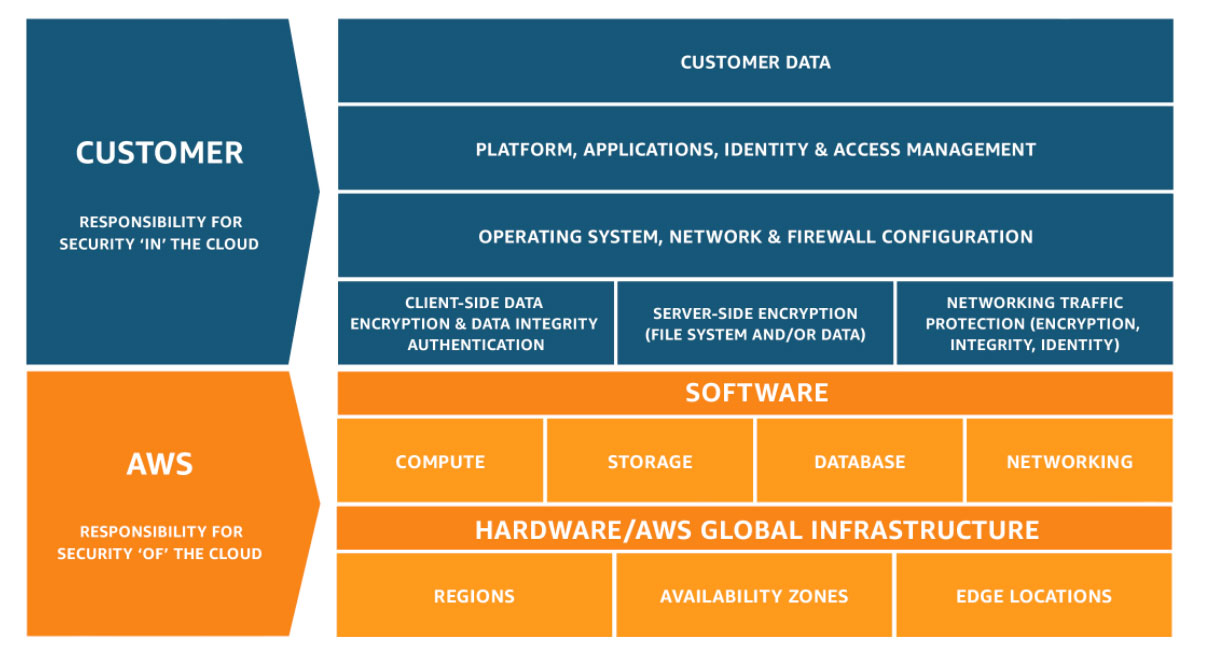
## Shared Responsibility Model
- CUSTOMER = RESPONSIBILITY FOR THE SECURITY **IN** THE CLOUD
- AWS = RESPONSIBILITY FOR THE SECURITY **OF** THE CLOUD
* * *
[ Index](../README.md) [IAM: Identity Access & Management
  ](./iam.md)